I read the article “South Florida Faces Ominous Prospects From Rising Waters” by Nick Madigan. It described how Southern Florida could possibly be affected by a rising sea level. The state as a whole is already vulnerable to flooding, but the floodwaters generally recede after a time (albeit leaving significant damage). The rising water level would obviously exacerbate the current flooding problems, but it is possible that the waters would never recede. This could potentially cause Floridians to lose billions of dollars in property values alone as well as schools, roads, and power plants. Community officials and environmentalists are leading the charge, but there is a crucial piece missing. Despite the urgency of the problem, the business community is not actively searching for a solution. Without businesses involved, there is a lack of funding and initiative within politics, yet progress has been made. Some environmentalists are looking at ways other nations and states have dealt with drainage problems. Community Official, Jim Morales, is sure that humans can engineer a solution. “Ultimately, you can’t beat nature, but you can learn to live with it.”
I thought this article was especially relevant to Bronxville Students because our own school, field and playground have been severely flooded multiple times. The first major flood in my lifetime was when I was in 5th grade. I did not attend the school, but I lived in the village, so I went over and took pictures. The amount of water inside and outside the building was astounding, and the repairs cost millions of dollars. Community officials claimed that this was a once in a lifetime event, but a similar flood hit in the fall of 2011. An interesting parallel between Southern Florida and Bronxville is that the residents of Field Court and other low-lying areas have pushed for drainage repairs for years which could have prevented the 2011 flood, but the rest of the town only cares about drainage issues when they have to pay more taxes.
This article documents the problems associated with rising water levels very well. The explanations are clear, and there are additional quotes from scientists and community leaders showing the issues that they must work through before a solution can be implemented. However, I wish the author could have further explained what the solution was instead of focusing on politics.
Manigan, Nick. "South Florida Faces Ominous Prospects From Rising Waters." New York Times. N.p., 10 Nov. 2013. Web. 12 Nov. 2013.
http://www.nytimes.com/2013/11/11/us/south-florida-faces-ominous-prospects-from-rising-waters.html?pagewanted=2&_r=0&ref=science
Wednesday, November 13, 2013

A Jolt to Complacency on Food Supply
The article that I read is called
“A Jolt to Complacency on Food Supply.” It explained how climate change could
destabilize the world’s food system and, in the future, could cause rising
hunger or even mass starvation. The author gave an example of this negative
effect by looking at the effects of the mass heat wave on the corn crop in the
beginning of 2012. The heat caused plants to wither and prices to spike. These
negative impacts are only expected to get worst as time goes on. Scientists
were hoping that an increase in carbon dioxide in the air due to fumes could
offset the heat and water stress since carbon dioxide is a main food supply for
plants. Unfortunately, after doing tests, scientists have concluded that it isn’t
enough to offset the stress of global warming. However, none of these results
are definitive until more research is conducted.
This
article is very important because if a solution is not found to the problem of
the negative effect of global warming on crop yield, than there could be mass
starvation and rising hunger due to limited supplies of food. However,
scientists are confident that they can find a solution because agriculture has
a tremendous capacity to adapt to new conditions, including a warming climate.
For instance, plants could be planted earlier and new varieties that are more
resistant to climate stress can be developed.
I
thought the author did a poor job relaying such important information, to be
honest. The article had many short paragraphs that jumped around and were hard
to follow, in my opinion. However, the author did make good use of past examples
of negative effects of climate change, such as in 2012 with the corn crop.
Also, I liked that the author ended the article with a positive outlook by explaining
that scientists are confident that many solutions can be found for this problem.
Overall, I enjoyed this article for the informative content but not for the
writing skills of the author.
Article: http://www.nytimes.com/2013/11/12/science/earth/warning-on-global-food-supply.html?ref=science&_r=0
Monday, November 11, 2013
Bacteria May Allow Animals to Send Quick, Voluminous Messages
I read the article “Bacteria May Allow Animals to Send
Quick, Voluminous Messages.” This article is about the scent bacteria carried
by hyenas and how that relates to animal-to-animal communication. Hyenas are
able to leave behind a paste, individual to each animal, which is comparable to
leaving a message to someone. This symbiotic bacterium that is left behind is used
as an information bank for every hyena that smells the paste left behind by
another hyena. One animal can know everything about another just by coming in
contact with their paste. A study was recently done on hyenas, leading to the
discovery of the complex and diverse system of odor producing bacteria possessed
by hyenas, giving them the ability to conduct this type of advanced molecular
communication. It was also discovered that there is a major variance between
male and female hyenas, and also hyenas of different species and origins. After
these discoveries, the scientific team that conducted this research stated “The next phase of
this research will be to manipulate the bacterial communities in hyenas' scent
glands to test if their odors change in predictable ways."
This
discovery is so important to science because previous to this, there was no
prior knowledge of the magnitude of the hyena’s ability to communicate through
these odorous pastes. There had been studies conducted before, but using such
traditional methods, no real data or proof was collected. These discoveries
could also lead into a plethora of other scientific experiments, including
replicating this experiment with other mammals to see if they posses the same
ability as the hyenas. All animals have different ways of producing scents and
sending messages, and this study could bring the scientific community closer to
discovering what is behind this natural animal instinct.
I
think this article was very interesting and was written very well. I especially
liked the analogy of the scent being compared to twitter. In a tweet, you can
only use 140 characters to get your point across, but a lot can be revealed in
those 140 characters, and the author of this piece was very creative in
relating that concept to the idea that these animals can leave a little piece
of themselves behind that can reveal a lot to other animals. I think that this
was also a way to grab the attention of a younger audience and make such a
complex and scientific article become more relatable. Overall, I think it was a
great article, and it was very interesting to read. I would love to learn more
about the results of the upcoming experiements.
SOURCE:
Michigan State
University. "Bacteria may allow animals to send quick, voluminous
messages." ScienceDaily, 11 Nov. 2013. Web. 11 Nov. 2013
Sunday, November 10, 2013
Making Robots More Like Us
Although the topic of robots may not seem to be connected to the study of biology at first, if we take a closer look into the cutting edge of robot manufacturing is it evident that biology plays a large role in the creation of humanistic robots. I read an article titled “Making Robots More Like Us” by John Markoff and discovered many interesting and exciting details about the world of robot engineering. This article discusses the changes that have been taking place regarding the application of robots and how they will function in the future. Markoff writes, “Until recently, most robots were carefully separated from humans. They have largely been used in factories to perform repetitive tasks that required speed, precision and force…the industrial era of robotics is over.” Now robots are not only being programmed to have some of the same chemical and biological responses that humans have but they are also being made to look like humans. “Moreover, the new robots are designed not just to replace but to collaborate with humans.”
The science and industry of robots is becoming more and more popular and is becoming recognized as a legitimate and vital field of study. “Today’s robot designers believe that their creations will become therapists, caregivers, guides and security guards, and will ultimately perform virtually any form of human labor.” Robots are ultimately the answer to the future; they are opening and will continue to open new opportunities to people of all walks of life. They will also revolutionize the field of medicine in ways that will save thousands of lives. Furthermore, Markoff writes, “To function in the real world and to be safe, robots must have a radically different design from factory robots, which are based on “stiff” actuators capable of moving with great speed to a precise position. The new robots have “compliant actuators,” which respond to external forces by yielding in a natural fashion.” Robots will be able to carry out actions that will not only make ordinary life easier but will also be able to carry out extraordinary feats that will revolutionize the ways in which we approach life as a whole.
This article was written in such a way that it was both easy to understand and interesting to read. The writing was clear and concise and the author’s voice was authoritative and exciting. I also really enjoyed the media that was included along with this article. A video of the different types of robots was attached to the article which helped me to visualize the complex structures that were described in the article. This made it easier to understand exactly what the author was saying. Furthermore, pictures were included along with this article which added to my level of understanding. Overall, this article was interesting and informative.
Markoff, John. "Making Robots More Like Us." New York Times. The New York Times Company, 28 Oct. 2013. Web. 10 Nov. 2013. <http://www.nytimes.com/2013/10/29/science/making-robots-more-like-us.html?ref=science&_r=0>.
Monday, November 4, 2013
Cosmic Census Finds Billions of Planets That Could Be Like Earth
Overbye, Dennis. "Cosmic Census Finds Billions of Planets That Could Be Like Earth."The New York Times. N.p., 4 Nov. 2013. Web. 4 Nov. 2013.
The article I read, “Cosmic Census Finds Billions of Planets That Could Be Like Earth,” by Dennis Overbye, discussed the discovery that we have around 40 billion known planets that are similar to earth. These planets are defined as being approximately earth-sized, circling a sun-sized star, with moderate temperatures, and getting within ½ to 4 times as much sunlight as earth does. NASA had a spaceship, the Kepler, keeping track of this data, which was launched four years ago. It had discovered over 3,500 such planets and gathered the data to project the total to over 40 billion before its mechanical failure in May. Stars which the closest planets orbit, “would be visible to the naked eye,” said Erik Petigura, a graduate student at UC Berkley who has written extensively on the topic. These closest planets might even be 12 light years away, which would be close enough for us to study.
Finding planets similar to earth that we can study is groundbreaking. Geoffrey Marcy, who oversaw Petigura’s work, even felt that, “this is the most important work I’ve ever been involved with.” We can see how planets that are further along than our earth function, predict where we might be headed as a planet, and better understand our planet. With similar conditions to those of earth, these planets might also host life. It is statistically improbable that we are the only living beings in the universe, and the recent findings that there are at least over 40 billion similar planets leads many to believe there is a good chance we are on the track to finding other habitable and habited planets.
I would have liked to know more about the Kepler craft--its original mission and further examples of what data it collected. I’d also like to know why it malfunctioned, why can’t we fix it, and what kind of setback does it present us with. I did enjoy the article’s speculation, but the author could have utilized more facts in order to more support his ideas and the conclusions he drew. However, overall he did a good job of explaining what happened and its significance in simple terms.
“Climate Change Seen Posing Risk to Food Supplies”
As the title implies, this article pertains to
the increasingly relevant issue of climate change, and it’s effect on the
planet’s food supply. The article acknowledges that while the rising
temperatures may increase crop production in some places, the global result
will be a dramatic reduction in production. Overall reducing production, “as
much as 2 percent each decade for the rest of the century, compared with what
it would be without climate change.” Adding to the issue, our rapidly
increasing population means that demand for these crops is expected to rise,
“as much as 14 percent each decade.” The article informs the reader that there
are previous assumptions that are no longer accepted, such as the belief that
food production could dramatically increase in coming decades due to higher
carbon dioxide levels in the atmosphere. In addition to climate change’s impact
on crops, the article touches on its impact on animals, noting that plants and
animals will colonize new areas to escape rising temperatures, and that many
could become extinct. The article explains unfortunate cycle- that global food
demand might have to be met by putting new land into production. This could
mean, “chopping down large areas of forest, an action that would only
accelerate climate change by sending substantial amounts of carbon dioxide into
the air from the destruction of trees.” While reviewing the dangers of climate
change, the article also manages to offer some hope. It reveals that hundreds
of billions of dollars are being spent every year to reduce carbon dioxide emissions,
even though these efforts are so far said to be, “inadequate to head off
drastic climatic changes later in the century.” President Obama also signed an
executive order on Friday to step up these efforts in the US. Still, the
article makes the point that more intensive and expensive plans will have to be
put in place.
The information provided in the
article profoundly affects humanity for obvious reasons. If we personally don’t
experience this expected food shortage in the next few decades, we can be sure
our children and grandchildren will. If not yet leaving us hungry, the issue
will affect humanity because, any shortfall in food supply, “would lead to
rising food prices that would hit the world’s poor hardest, as has already
occurred from price increases of recent years.” The affect on humanity also
depends on where one is living. For example, the article says that the
agricultural risks are greatest for tropical countries due to their higher
poverty rates and “projected impacts that exceed adaptive capacity.”
Overall,
I found this to be a very informative article. It seems reliable as it cited
its sources of information, it is clear and it is concise. It outlined the
major issues of the effect of climate change on food production, and ended with
some optimism about the future. The article could have been thorough in some
respects. For instance it could have been more specific about procedures taken
to limit carbon dioxide emissions. Overall, though, the article did not strike
me as lacking and was a very interesting read.
Friday, November 1, 2013
AP Biology Cellular Respiration Inquiry Lab
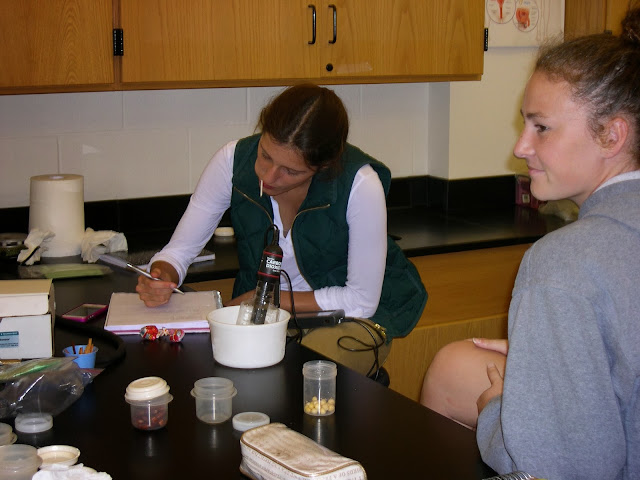
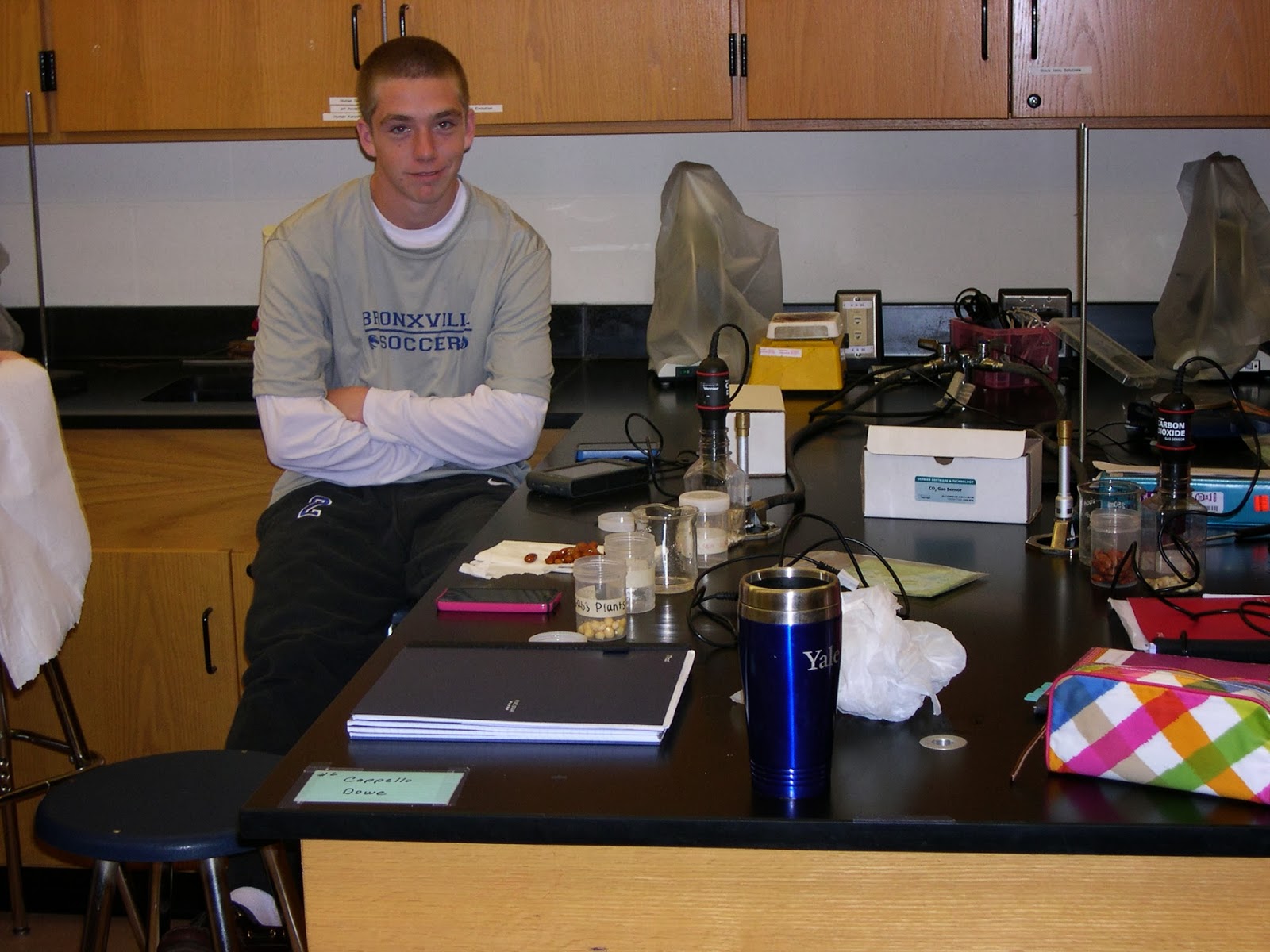
The AP biology class carried out a study of the rate of respiration in germinating seeds. In the basic protocol they soaked "wrinkled pea seeds" for 48 hours and compared their respiration rate to the control of "glass beads". The students used either Vernier carbon dioxide gas probes or Vernier gas pressure probes to measure the release of respiratory gases. After the initial run, the students compared rates in different seeds of their choice (barley, kidney beans, corn, black eyed peas) at different temperatures (in ice baths and at room temperature). They even compared seed of varying ages (48 and 92 hours).





Subscribe to:
Posts (Atom)