Friday, November 1, 2013

AP Biology Cellular Respiration Inquiry Lab

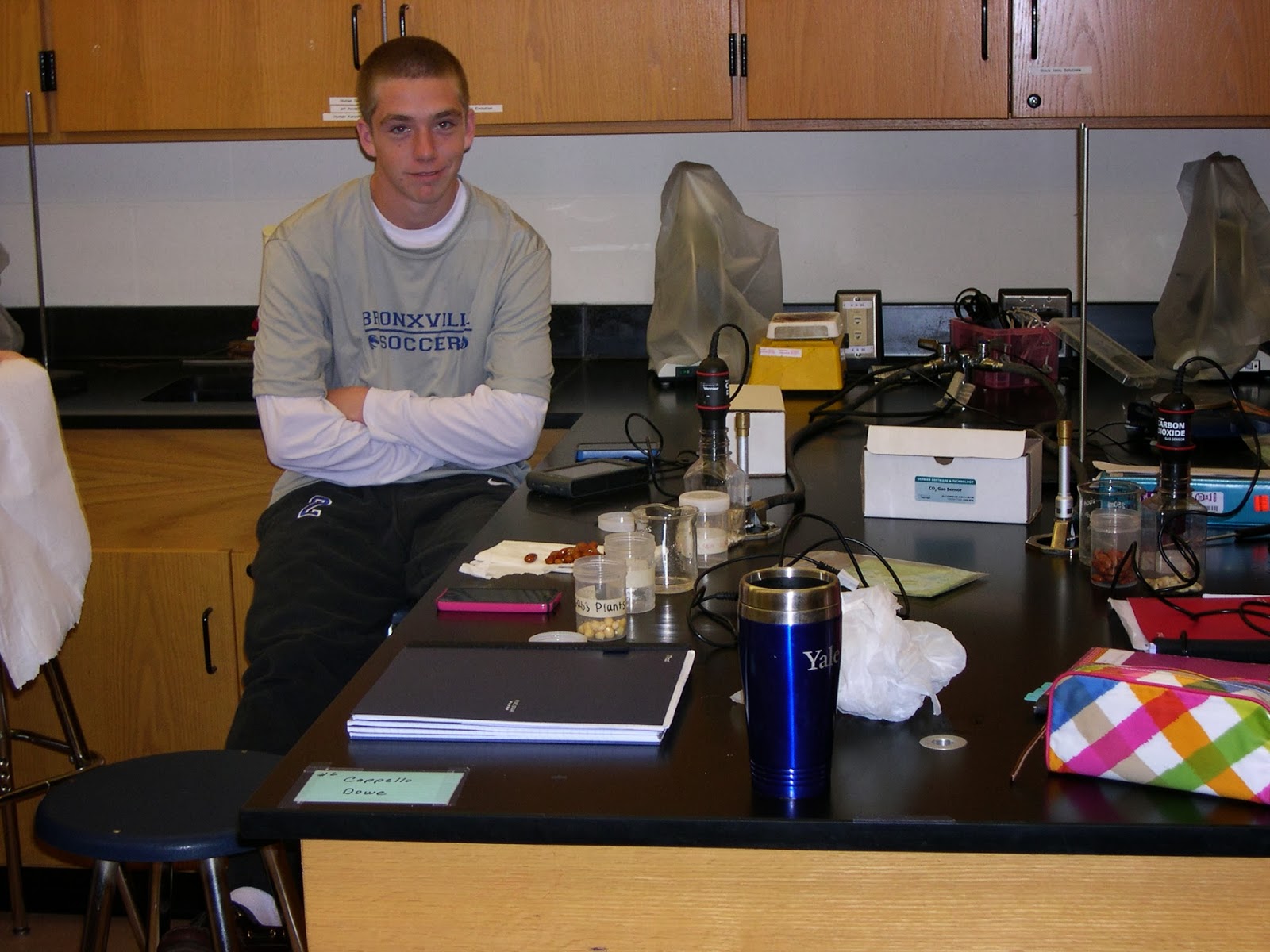
The AP biology class carried out a study of the rate of respiration in germinating seeds. In the basic protocol they soaked "wrinkled pea seeds" for 48 hours and compared their respiration rate to the control of "glass beads". The students used either Vernier carbon dioxide gas probes or Vernier gas pressure probes to measure the release of respiratory gases. After the initial run, the students compared rates in different seeds of their choice (barley, kidney beans, corn, black eyed peas) at different temperatures (in ice baths and at room temperature). They even compared seed of varying ages (48 and 92 hours).

Saturday, October 19, 2013

World Ocean Systems Undermined by Climate Changes in 2100

I read the article “World Ocean Systems Undermined by Climate Changes in 2100.” This article explains the new study that describes a full chain of events of changes that could affect humans and ocean systems in the year 2100. Earlier discoveries on ocean systems focused mainly on the amount of acid and the warming of the oceans, but the ocean biogeochemical changes triggered by the manmade greenhouse gases are being ignored. The biogeochemical cycle is the flow of chemical elements and simple substances between living organisms and the physical environment. This cycle is being hindered by manmade greenhouse gases, which are ultimately hurting the environment. Scientists say that almost all of the world’s ocean surface will be impacted greatly due to the intensities of ocean warming, acidification, and reductions in oxygen and productivity. The greenhouse gases that are hindering the biogeochemical cycle is potentially hurting our environment now and in the future. Author Camilo Mora says, “The consequences of these co-occurring changes are massive-everything from species survival, to abundance, to range size, to body sixe, to species richness, to ecosystem functioning are affected by changes in the ocean biogeochemistry.” To continue, human ramifications are likely to be very massive-food chains, fishing, and even tourism of countries could be impacted largely. Millions of the world’s poorest people rely on the ocean for food, jobs, and revenues, which could all disintegrate very rapidly.

I liked reading about this article. When I was flipping through the choices of articles, this one caught my attention instantly. As I was reading it I became a little confused with context, but as I read on, it made more sense. I believe this article is important because it gives us insight to how our own works could potentially harm our world and oceans causing problems with food, jobs, and resources later on in the years. I realized that whether this takes place in modern times or in 100 years from now, we are contributing to whatever may happen and therefore; we need to fix it as well
. http://www.hawaii.edu/news/article.php?aId=6053

Thursday, October 17, 2013

Skull Fossil Suggests Simpler Human Lineage


Ted Forst
AP Biology
I read the article, “Skull Fossil Suggests Simpler Human Lineage” by John Noble Wilford in the New York Times.  The article is all about how the discovery of a 1.8 million-year-old skull, called Skull 5, may completely change previous ideas about human ancestors. The original belief was that modern day humans came from a long line of distinct species like the Homo habilis and the Homo erectus.  The information discovered from this new skull suggests that these distinct species may in fact all be variations of one species.  In our world today, people from around the world look very different.  This article suggests that the same thing would be true millions of years ago.  Our ancestors most likely differed from each other depending on their location.
Skull 5 was originally discovered in 2005, and after eight years of studying it, a group of scientists led by David Lordkipanidze was able to determine this revelation in human ancestry.  The group called Skull 5 “the world’s first completely preserved adult hominid skull.”  The skull had a long, apelike face, big teeth, and a small case for its brain.  In fact, the braincase was about one-third of the size of those of modern human beings, which also disproves that larger brains were necessary for the hominids to leave Africa, as the skull was found in the Republic of Georgia.  The discovery that proves all of these beliefs is that four other skulls were found near the site of Skull 5.  These four other skulls lived around the same time as Skull 5 and in the same area.  The interesting thing is that they differed no more than any five modern humans or chimpanzees.  This means that they were one species, which led the scientists to the conclusion, based on the minimal variation, that there was also a single homo species at that time in Africa too.
Skull 5 also shows what the species was like 1.8 million years ago.  It was deduced based on surrounding bones that the hominids were short, but able to walk long distances standing upright.  In their report, Lordkipanidze and the other scientists wrote that Skull 5 “provides the first evidence that early Homo comprised adult individuals with small brains but body mass, stature and limb proportions reaching the lower range limit of modern variation.”
I think that this is a really great article, as it completely changes our thinking about our ancestors.  I had little knowledge about the topic before reading the article, and I thought that John Noble Wilford did a great job simplifying the material, making it easy to understand while keeping it interesting.  


Rosetta: 100 Days for Comet-Chasing Mission to Wake-Up

Rosetta: 100 Days for Comet-Chasing Mission to Wake-Up http://www.sciencedaily.com/releases/2013/10/131011111111.htm

      This article shares information about the comet chasing orbiter Rosetta. Before it gets into the details of Rosetta’s mission it explains what the importance of comets are, and that is they are the source of Earth’s water. It also explains how studying comets can help us realize how the solar system evolved. Rosetta was launched on March 2, 2004 and has been orbiting Earth and other planets since. In July 2011 Rosetta was detected near Jupiter, 800 million kilometers from the sun, and it was put into “deep-space hibernation”. Deep-space hibernation gives the orbiter a chance to keep stability and to absorb as much sunlight as possible. Ever since 2011 the orbiter and the comet it is following has been approaching the center of the solar system which means Rosetta can finally come out of hibernation and land on the comet. Scientists say that Rosetta is supposed to wake up on January 20th, 2014 at 10:00 GMT. But before it can land it has to send many signals back to Earth and various parts have to be checked. Once everything is working and scientists have received the signals they can start getting pictures and information which is expected the following May. If Rosetta is clear to land it can finally start sending information back to Earth.
   
        Rosetta affects humanity because it will be the first time that anything has attempted to land on a comet. If it lands it can send panoramic pictures of its surroundings and it can perform many experiments finding out what comets are made of. Matt Taylor, one of ESA’s Rosetta project scientists says, “This unique science period will reveal the dynamic evolution of the nucleus as never seen before, allowing us to build up a thorough description of all aspects of the comet, its local environment and revealing how it changes even on a daily basis.” If Rosetta is able to come out of hibernation, next spring, a lot of information will be sent back to Earth. Some of the information includes, as stated in the article, “Rosetta will also make important measurements of the comet’s gravity, mass and shape, and will make an initial assessment of its gaseous, dust-laden atmosphere, or coma...and analyze how it interacts with the Sun’s outer atmosphere.” This shows how much beneficial information Rosetta can provide us with.
     
      I thought this article was very informative but I wish it gave more information one what it has been doing in space for all this time. It explains how it went into hibernation in 2011 and how it photographed meteors in 2008 and 2010, but what was it doing from when it was launched till then? I also wish this article gave information of how much longer Rosetta is expected to be in space, because it hasn’t even landed and it’s been in space for almost 10 years and it isn’t even that close to the comet yet. One last thing that I didn’t like about the article was I actually found a spelling mistake, which made the whole article seem less professional to me.

Could This Be The End Of Cancer?


Chrissy Simon

Could This Be The End Of Cancer?
Shari Baker was diagnosed with stage IV (metastatic) breast cancer in 2005. To combat the cancer, she began searching for a clinical trial and through the International Cancer Advocacy Network, she learned about cancer vaccines. In May 2006, she traveled to the University of Washington and received a vaccine injected into her upper arm. Over the next five months, she got five more shots. Today, scans detect no cancer anywhere in her body. Researchers have a good idea of how the vaccines worked because of studies done by scientists on lab animals and cells in petri dishes. First, the vaccine contained fragments of a molecule called her2/neu. This molecule encourages the growth and propagation of some breast cancers when it is suspended on the surface of tumor cells. Baker’s immune system treated the stream of injected her2/neu like an invading army and counterattacked. Next, cells called CD4, acted like biological Paul Reveres, sounded the alarm, and stimulated white blood cells called T cells. The body’s Minutemen activated reinforcements called cytotoxic T cells, which invaded Baker’s tumor. Finally, the T cells destroyed the tumor cells in Baker’s breast as well as her spine.
            I think that this article is extremely important to society. After decades of hopelessness, scientists have hit on a potential cure that few thought possible a couple of years ago. If they succeed, cancer vaccines would change future treatments. They could end the need for chemotherapy and radiation. Both of which can have horrific side effects, which tumor cells often become resistant to, and which often do not help cure the disease much. Vaccines could make these treatment options a thing of the past and could make cancer as preventable.
            The article does a good job of explaining how the vaccine works in a way that the average person can understand, using analogies from the American Revolution. Also, the author provides numerous examples of different vaccines that are being tested. The article also does of a good job of explaining the importance and significance of the information it presents. However, there are some areas that the author of the article could have improved on. For example, the author does make some assertive statements without explaining why. For example, when the author discusses radiation and chemotherapy treatments and because the side effects could be so detrimental, some alternative practitioners recommend against it, the author states,  “Following that advice can be fatal.” The author does not explain why that could be the case.  In another part of the article, the author writes, “cervical cancer vaccines….target cancer causing viruses; most cancers aren’t caused by viruses.” The author does not explain the contradiction included in the sentence. The article is packed with many facts and examples. However, at some points, it seems that the author may have included too much information to convince the reader about the importance of the cancer vaccine. Overall, however, I really enjoyed reading the article and learned so much about a possible cure for cancer.

Citation: "Could This Be The End Of Cancer?" Newsweek. N.p., n.d. Web. 11 Oct. 2013. <http://mag.newsweek.com/2011/12/11/could-this-be-the-end-of-cancer.html>.

Link: http://mag.newsweek.com/2011/12/11/could-this-be-the-end-of-cancer.html

Monday, October 14, 2013

"Plenty of Water, But Little to Drink" Review by Abigail Roesser


Abigail Roesser
AP Biology
Current Event

            I read the article, “Plenty of Water, but Little to Drink” by Cornelia Dean in the New York Times. The article is about how even though most of Earth’s surface is covered with water only 5% of it is fresh water, which is mostly tied up in sheets that we cannot reach because they are so far underground. Then the author proceeds to discuss how this causes us to draw more water from underground aquifers fasters than the aquifers can refill. Aquifers are a body of permeable rock that can contain or transmit groundwater. The problem with the small amount of water that we do have is often polluted by sewage, industrial waste, and parasites, which makes natural water under the ground unsafe to drink. The author backs this information up by including information from James Salzman’s book “Drinking Water” where Salzman discusses how 1 in 70 Americans due of a waterborne diseases before the age of 70. The author also includes information about how water is critical to economic, social, and cultural development for thousands of years. She provides support for this by saying, “Steven Mithen tells us in “Thirst.” An archaeologist at the University of Reading in England, Dr. Mithen covers a vast portion of the ancient world: water storage in ancient Sumeria, the terra cotta pipes of classical Athens and the aqueducts of Rome, the “hydraulic city” of Angkor Wat in Cambodia, the water-allocation policies of the Maya.”
            This article is very important to our society today because clean water access has been an issue for many other countries. For example, in many countries thousands of people don’t have access to clean water and that causes them to die from drinking dirty water filled with parasites and diseases. This article draws attention to a large issues that is growing as the population grows and hopefully will lead people to help solve the problem. One thing that we can do to prevent this problem is to come up with new technologies of cleaning water or conserving more water.
            I really enjoyed reading this article because the author made it very clear and detailed of the issues of water. The article was really good about giving background information on the issue. And I also like how the author included information from books and other scientists. However, I thought that the article could have discussed some more solutions for the issue rather than discuss the problem. Overall, I thought that the article was very informative.


Saturday, October 12, 2013

Pancreatic Cancer: Chemo Drug Gemzar Improves Survival Rates


MacGill, Markus. "Pancreatic Cancer: Chemo Drug Gemzar Improves Survival Rates." Medical News Today. MediLexicon International Ltd, 09 Oct. 2013. Web. 12 Oct. 2013.


            The article, “Pancreatic Cancer: Chemo Drug Gemzar Improves Survival Rates,” written by Markus MacGill, reports that patients, who are treated with the drug gemcitabine six months after having surgery to remove pancreatic cancer, will survive longer. Gemcitabine is a chemotherapy drug marketed in the US under the name Gemzar. Authors conclude that gemcitabine results in a 24% improvement in survival. Researchers found that, in addition to pancreatic surgery removal, the use of gemcitabine improves the overall absolute numbers of people surviving five years. Specifically, 10.4% of patients survive for five years while not being given gemcitabine, while 20.7% of patients survive for five years while being treated with gemcitabine. Furthermore, there was a 4.5% increase in the 10-year absolute survival rate when taking gemcitabine. Helmut Oettle, of the Berlin University Hospital Charité in Germany, investigated whether gemcitabine improved overall survival rates as well as freedom from disease progression. Thus, patients who had their pancreatic cancer fully removed by surgery participated in this investigation. The patients entered the study between July of 1998 and December of 2004 from a variety of hospitals located in Germany and Austria. 354 patients had been analyzed with 308 having cancer relapse. However, after analyzing their data and comparing them to those who only received observation, researchers have concluded that the adjuvant use of gemcitabine for six months led to an increased overall survival as well as disease-free survival.

            According to the article, “…pancreatic cancer is responsible for 227,000 deaths worldwide every year, and is the eighth most common cause of death from cancer” (MacGill 2013). Having the availability of a drug that will increase overall survival as well as disease-free survival, is helpful and incredible. Gemcitabine is also licensed for use in advanced ovarian cancer, metastatic breast cancer, and non-small cell lung cancer. Cancer has become so common; although scientists do not know all the reasons why cancer occurs, they do know that cancer can be due to heredity, diet, hormones, chemicals, environment, radiation, and viruses or bacteria. Gemcitabine can benefit many people and open the door to more research in the field of oncology.

            The article was interesting and educational. It connected to me because my grandmother passed away from pancreatic cancer. Therefore, while reading the article, I was siding with the author, thinking that gemcitabine is useful. However, the author should have also pulled in the other perspective, how the drug can be harmful. MacGill should have included the side-effects or any negative sides of the drug.